yuzhe.dev: a $0 bilingual portfolio, built fast with AI and kept honest with specs and tests
My own site: positioning, bilingual content, case studies, a searchable blog and a project-brief flow. V1 in three days with an AI coding agent, then audited and locked down. Lighthouse 100 on desktop.
- Role
- Solo — positioning, content, design, development, SEO, operations
- Stack
- Next.js 16React 19TypeScriptTailwind CSS 4MDXFuse.jsVercelCodex
Overview
- Challenge: a decade of backend work is invisible to an overseas founder skimming a profile for thirty seconds.
- Solution: a bilingual site with services, case studies, a searchable blog and a project-brief builder — on zero paid infrastructure.
- Results: live since May 2026; Lighthouse 100 / 100 / 100 / 100 on desktop and 96 / 100 / 100 / 100 on mobile; content rules enforced by automated tests.
The challenge
The site has four jobs at once: proof for freelance clients, a public log of building a one-person business, search traffic, and an entry point to future products. Two constraints shaped everything — near-zero cost until it earns money, and a strict truth standard: no invented clients, numbers or links, and nothing labelled Live unless it verifiably is.
What I built
- One clear path: Home → Selected Work → case study → Project Brief → WeChat / X / email. Every page has one primary call to action.
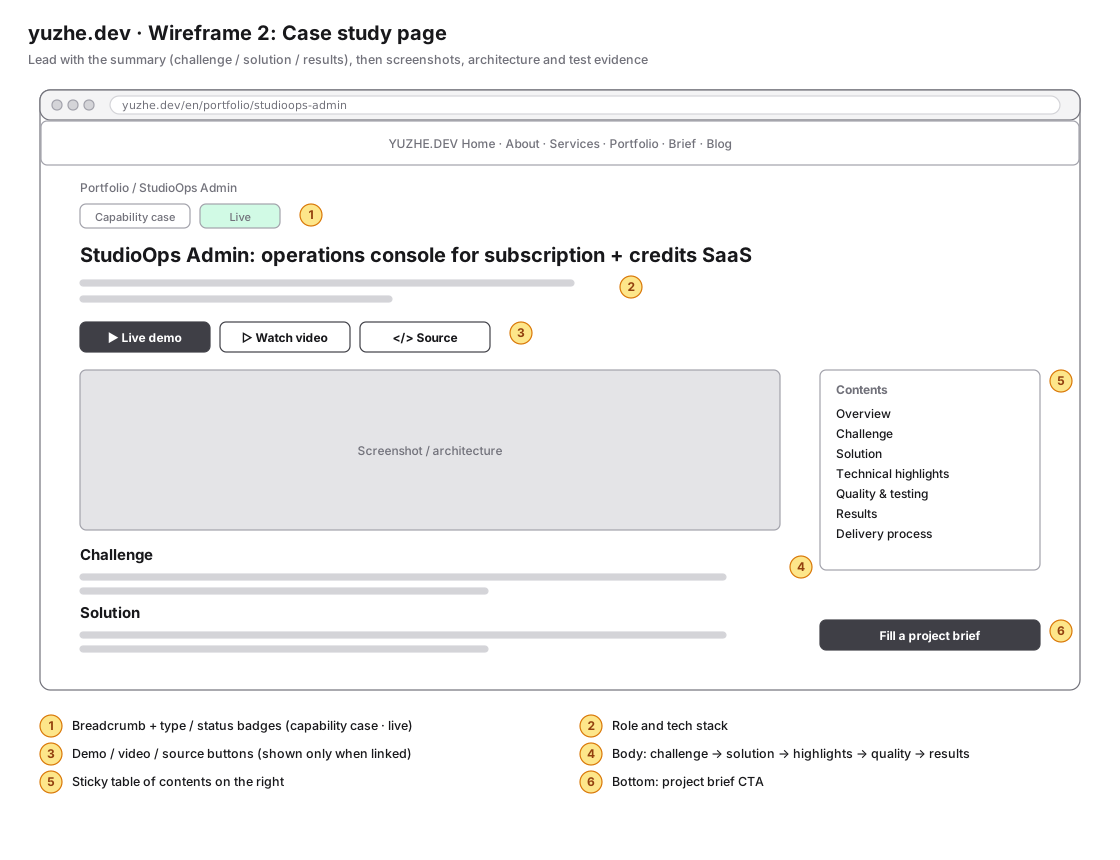
- Case studies like this one, each with screenshots, wireframes, architecture and test evidence.
- A Project Brief builder that turns a vague idea into a structured inquiry in the browser and never shows a fake "submitted" message.
- A searchable MDX blog in English and Chinese.
Technical highlights
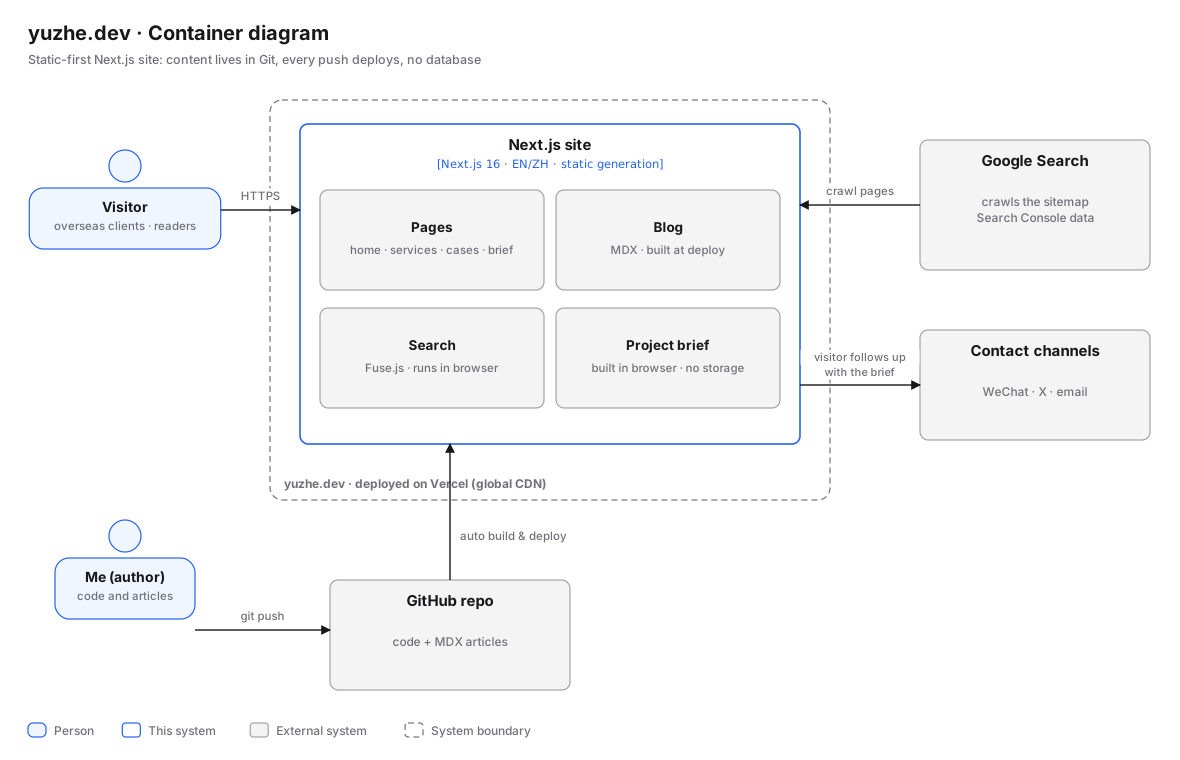
- Static-first Next.js on Vercel: content is MDX in Git, compiled at build time; no database, no form backend, nothing to pay for.
- Bilingual by structure: one JSON dictionary and one content folder per language, so adding a language is a locale, a dictionary and a folder.
- Client-side search with Fuse.js, including Chinese-numeral normalization.
- SEO foundation: canonical URLs,
hreflangpairs, sitemap, generated Open Graph images and honest structured data.
Built fast, then brought under control
V1 went from create-next-app to a live bilingual site in three days (May 27–29, 2026) with Codex as the coding agent. The follow-up audit found what AI-generated code often hides: placeholder contacts and dead links, garbled characters, a mobile layout that overflowed at 360 px, a missing Open Graph image, inaccessible interactions, and style changes that broke other components.
The fix wasn't patching. I wrote down the rules the AI must follow — a product brief with a content lock, a design brief, a spec per module — and added tests that enforce them: placeholders fail the build, status labels must be truthful, contact links must be real, every page needs one H1. When an AI edit drifts now, a test fails before a visitor notices. That is how I use AI on client work too.
Quality & testing
| Check | Result |
|---|---|
| Lighthouse, desktop | 100 · 100 · 100 · 100 (Performance · Accessibility · Best Practices · SEO) |
| Lighthouse, mobile (PageSpeed Insights) | 96 · 100 · 100 · 100 |
| Automated tests | Content quality, site structure, SEO endpoints, blog, case studies, layout regressions |
| Responsive checks | 360, 375, 768 and 1440 px |
How I delivered it
| Step | What was produced |
|---|---|
| Requirements | Product brief: audience, goals, truth standard, content lock |
| Prototype | Page flow and wireframes for home, case study and project brief |
| UI | Monochrome, code-oriented design rules |
| Architecture | Static-first Next.js, MDX in Git, no backend |
| Build | Codex for V1, then spec-first iterations |
| Testing | Node test runner, Lighthouse, manual responsive checks |
| Launch | Vercel, Google Search Console, sitemap with hreflang |